
الطيور
…
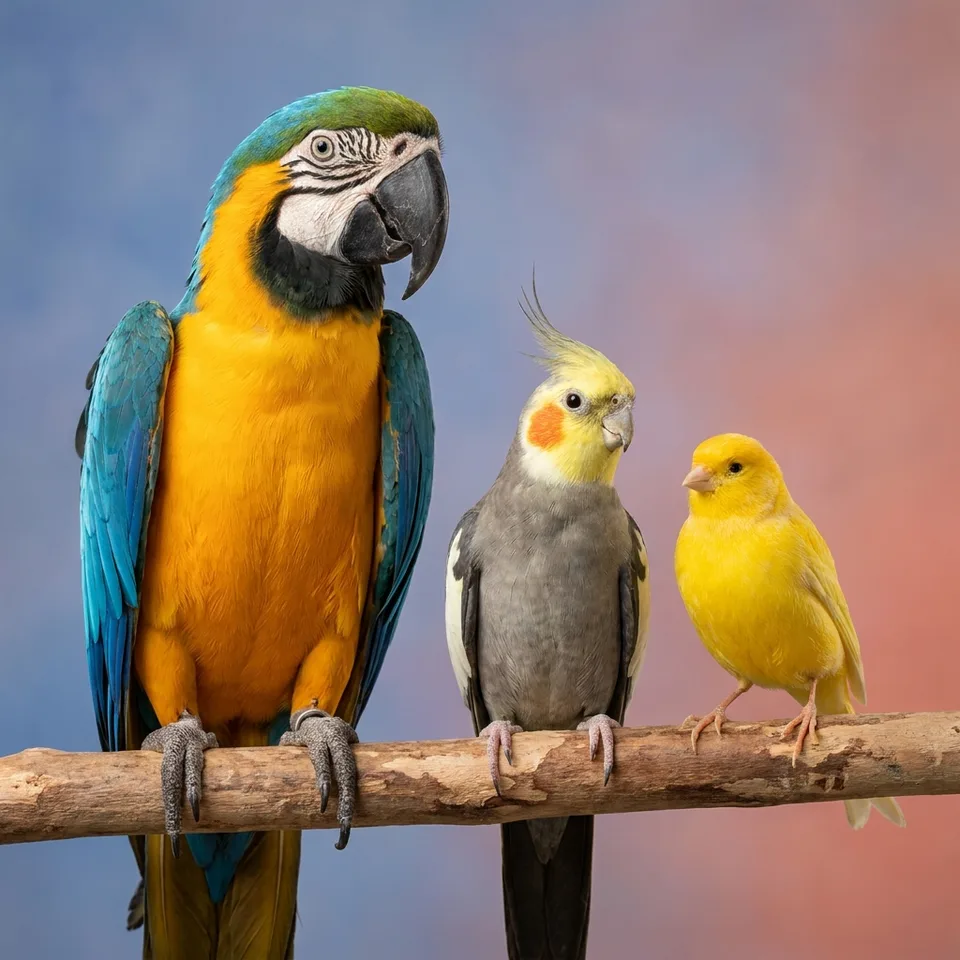
Companion birds range from the 30-gram budgerigar to macaws that outlive their owners, and almost all of them are, cognitively, wild animals a handful of generations from the flock. That means intelligence that needs daily work: parrots solve puzzles at the level of young children, learn dozens to hundreds of words, and without stimulation invent their own occupations — usually loud or destructive ones. The non-negotiables: the biggest flight cage you can house (width beats height for most species), daily out-of-cage time in a bird-proofed room, a varied diet where formulated pellets and vegetables displace seed mixes (an all-seed diet is slow malnutrition), and absolutely no Teflon fumes, avocado or scented candles — bird lungs are extraordinary and extraordinarily fragile. A single bird bonds hard to its human and needs hours of company; a pair keeps each other sane when you're away. Lifespan is the part everyone skips in the shop, and it is a moral question rather than trivia. A budgerigar may give you eight to twelve years, a cockatiel fifteen to twenty-five, an African grey forty to sixty, a large macaw or cockatoo fifty to eighty. Buy a grey in your thirties and there is a real chance the bird outlives you. Anyone taking on a large parrot should be able to name the person who will take it afterwards — and should have actually asked them. Screaming, biting and feather-plucking are almost never defects. They are symptoms. These are flock animals that were never built to spend twelve hours a day alone in a box, and a bird with nothing to chew, nobody to answer and nowhere to fly has nowhere to put itself. The cage dimensions printed on the box are a floor, not a target: buy bigger than the minimum, and treat flight time outside the cage as part of the day, not a reward. Find an avian vet before you need one. Birds are prey animals and hide illness until they cannot; a bird sitting fluffed on the cage floor is not slightly unwell, it is an emergency. Many general practices do not see birds at all, and the specialist may be an hour away — learn who and where on the day you bring the bird home, not on the night it stops eating.