
الزواحف
…
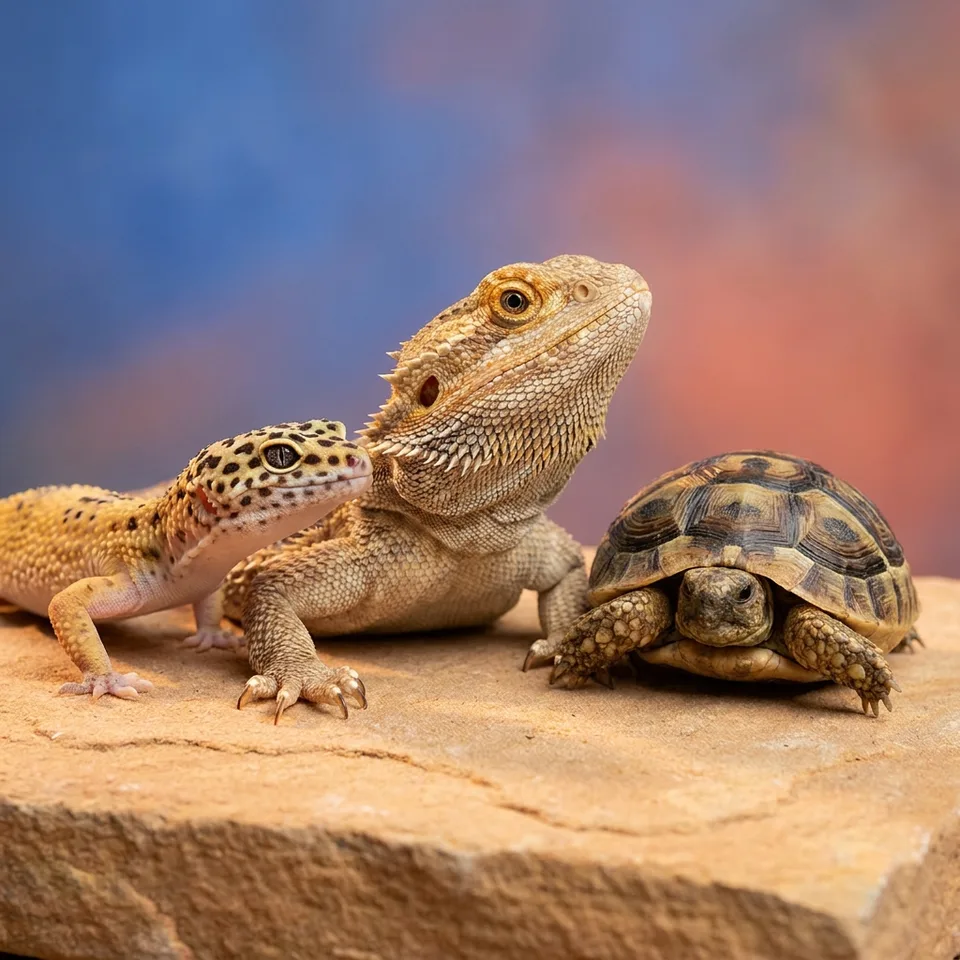
Reptiles run on borrowed heat: as ectotherms they regulate body temperature behaviorally, which is why husbandry — not medicine — decides their health. Every enclosure must offer a thermal gradient (a basking zone and a cool retreat), species-correct UVB lighting for vitamin D3 synthesis, and humidity matched to origin; the majority of reptile vet visits trace back to an error in one of these three. Say it plainly: a reptile cannot warm or cool itself from the inside — the enclosure is its life support system. It needs a warm end and a cool end so the animal can choose: for many desert baskers, a basking surface of 32–38°C (90–100°F) and a cool end of 22–25°C (72–77°F), with exact figures from the species profile. Measure at the animal's level with a digital probe and the basking surface with an infrared gun; stick-on dials read the glass, not the animal. Every heat source runs through a thermostat, always — an unregulated mat or bulb burns the animal lying on it precisely because it feels warm. UVB is the second dial. Diurnal baskers — bearded dragons, iguanas, chameleons, tortoises, most turtles — need it to make vitamin D3 and use calcium; without it they develop metabolic bone disease. Leopard geckos and most snakes manage without it, though a low-output tube helps. A UVB bulb stops emitting useful UV long before it stops looking bright, so replace it on a schedule — commonly every 6 to 12 months — not when it dies. Humidity is the third. Arid species want roughly 30–40%, rainforest species 60–80%. Too dry and sheds come off in patches, leaving constricting rings on toes and tail tips and stuck caps over a snake's eyes. Too damp with stagnant air brings scale rot and respiratory infection — open-mouth breathing, wheezing, bubbles at the nostrils — an urgent vet visit. The rewarding part: get the environment right and reptiles are among the most trouble-free companions there are. Leopard geckos and bearded dragons tolerate gentle handling and live 10–20 years; corn snakes are escape-artist puzzle boxes that eat once a week; tortoises will outlive the family car and possibly the family. Research the adult size before buying the cute hatchling — that 10 cm iguana becomes 1.5 meters of opinionated dinosaur. Before the animal: find a vet who genuinely treats reptiles and confirm it by phone, because most clinics do not. Check your own jurisdiction too — ownership rules, permits and CITES listings differ between countries and sometimes between cities. And look at rescues: they are full of surrendered reptiles, and an adopted adult shows you exactly what you are taking on.